You know short-term loans exist. What most people are less clear on is the mechanics beneath the surface — how the money actually moves, what lenders are doing when they assess your application, where the costs originate, and what happens when things do not go to plan.
That gap between knowing a product exists and understanding how it works is where most borrowing decisions go wrong. You accept an offer you have not properly evaluated, agree to a debit order date that does not align with your salary, or borrow more than the situation required because the approval came back higher than expected.
This guide closes that gap. Here is a complete, honest picture of how short-term loans work in South Africa — from the moment you apply to the moment the final repayment clears.
What a Short-Term Loan Is — and Is Not
A short-term loan is a fixed-amount, unsecured credit product repaid in monthly instalments over a period of between one and twelve months. It sits between a payday loan — which is repaid in a single lump sum within thirty days — and a personal loan, which can run for two to five years.
The defining features are its speed of access, its instalment structure, and its contained repayment period. You borrow a defined amount, repay it in fixed monthly deductions, and the obligation ends on a known date. There is no revolving balance, no variable repayment, and no open-ended commitment.
What it is not: a substitute for income. A short-term loan is a bridge — it is most useful when you have a specific expense that your current budget cannot absorb immediately but your income can service over a defined short period. It is not designed for ongoing financial shortfalls, and using it as one is where the cost compounds.
The most important question to ask before applying for a short-term loan is not ‘can I get approved?’ but ‘will the monthly repayment fit comfortably within my budget for every month of the term?’ If the answer is uncertain, the term or the amount needs to change.
The Application Process: What Actually Happens
You Submit Your Application
Most short-term loan applications in South Africa are completed online. The form asks for personal details, employment and income information, the amount you want to borrow, and the term you prefer. The documentation requirement is light relative to a personal loan — typically your South African ID, a recent payslip, and three months of bank statements from the account your salary is paid into.
The lighter documentation reflects the smaller amounts and shorter terms involved. Lenders are not underwriting a five-year commitment — they are assessing a six-month one. The risk profile is different, and the assessment process reflects that.
Income Verification
The lender does not take your declared income at face value. They verify it against your bank statements — looking for consistent salary deposits that match your stated figures, the timing of those deposits, and the pattern of existing debit orders running against your account. This tells them not just how much you earn, but how much of that income is already committed before it can reach a new repayment.
The Affordability Assessment
Under the National Credit Act, every registered lender must calculate your net disposable income before approving any credit. For a short-term loan, this means: net salary minus existing monthly debt repayments minus estimated living expenses. What remains is the figure available for new repayments. The lender’s assessment confirms that this figure can absorb the proposed monthly instalment without placing you under undue financial stress.
This is a legal requirement — not a courtesy. A lender who approves a loan without this assessment is guilty of reckless lending under the NCA, and the borrower has legal recourse if this occurs.
Credit Check
Your credit profile is pulled from one or more registered bureaus. Short-term lenders are generally more flexible on credit score than mainstream banks — current income and affordability carry more weight in their assessment models. But active debt review status, very recent defaults, or a pattern of missed payments on previous short-term loans specifically will affect the outcome.
Approval and Loan Offer
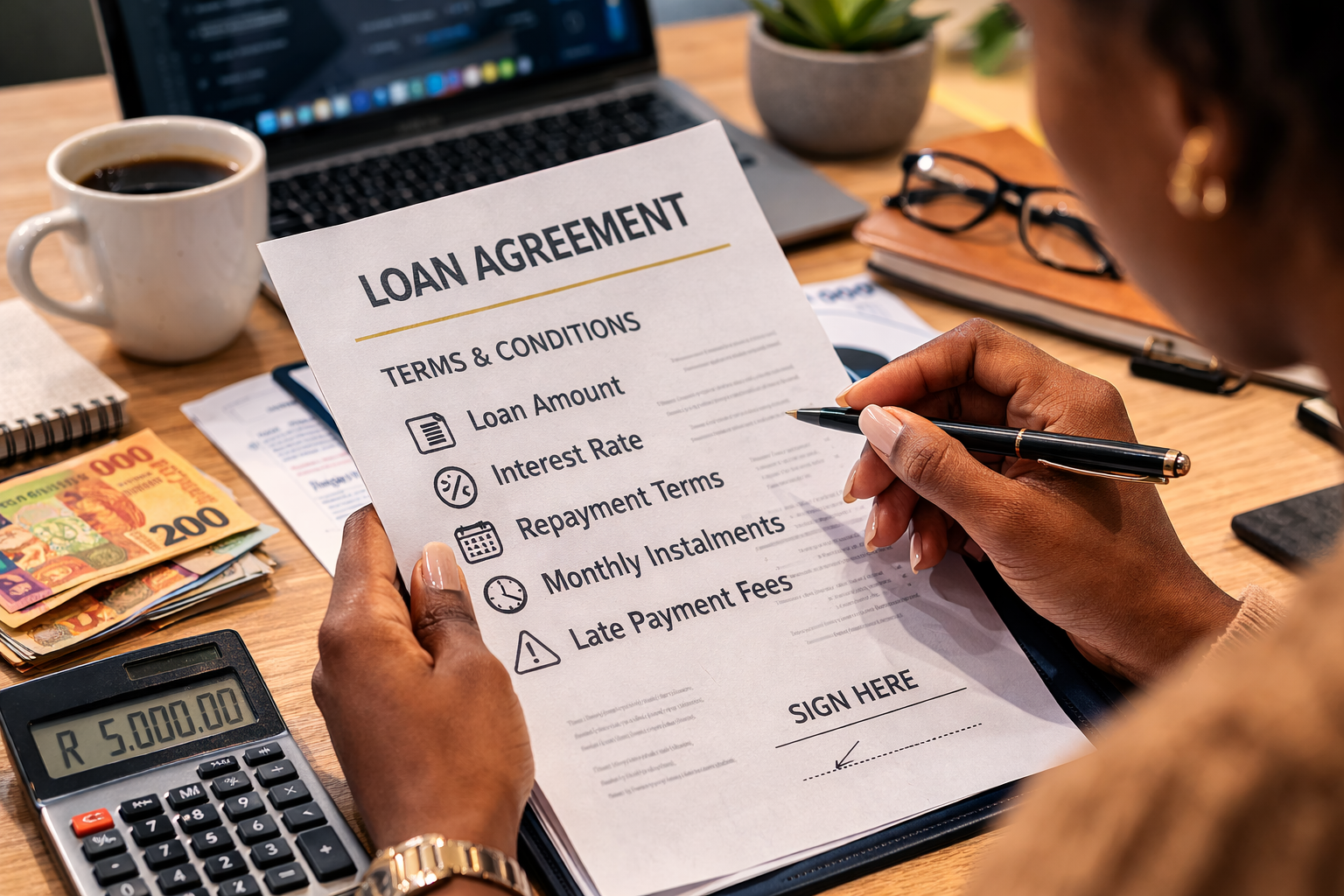
If your application passes the assessment, you receive a formal loan offer. This document is legally required to state the loan amount, the monthly instalment, the repayment term, the interest rate, all applicable fees, and the total cost of credit over the full loan period.
The total cost of credit is the number that matters most in the loan offer. Add it up yourself if the document presents the figures separately: loan amount plus all interest, fees, and insurance over the full term. That total, minus the amount borrowed, is what the loan costs you. Evaluate the loan on that number.
Acceptance and Disbursement
You accept the offer by signing the loan agreement electronically. Once signed, the lender processes the disbursement. Most online short-term lenders in South Africa transfer funds within 24 hours of a signed agreement — many do so the same business day. The funds arrive in the bank account you specified in your application.
The Repayment Structure: How the Money Comes Back
Fixed Monthly Instalments
Unlike a payday loan — which demands full repayment in one deduction — a short-term loan spreads the cost across the agreed number of months. Each monthly instalment includes a portion of the principal (the amount borrowed), plus interest calculated on the outstanding balance, plus any applicable monthly service fee.
As each instalment is paid, the outstanding balance reduces. Subsequent instalments carry a slightly lower interest component as the balance decreases — though for short-term loans, the term is brief enough that this progression is subtle rather than dramatic.
The Debit Order
Repayments are collected via debit order on an agreed date each month — typically aligned with your salary payment date. The debit order runs automatically, which removes the risk of a forgotten payment. The trade-off is that your account must have sufficient funds on the debit date to cover the instalment. A bounced debit triggers penalty fees from both the lender and your bank, and the missed payment is recorded on your credit file.
Confirm the debit order date before signing the agreement and ensure it is aligned with when your salary clears — not the day before, and ideally not the same day, to allow for bank processing times.
Early Settlement
You can generally repay a short-term loan before the end of the agreed term. This reduces the total interest paid, since interest accrues on the outstanding balance. Some lenders charge an early settlement fee — usually a defined number of additional interest days. Confirm whether an early settlement fee applies before making an early payment, and get written confirmation that the account has been closed once settled.
Where the Costs Come From
Short-term loans are more expensive than standard personal loans, relative to the amount borrowed. The cost components are regulated under the NCA but vary within those caps between lenders:
- Initiation fee: A once-off fee charged at the start of the loan. Capped by the NCA based on the loan amount. Typically deducted from the disbursed amount or added to the first repayment.
- Monthly service fee: A flat fee charged each month for administering the loan account. Regulated and capped. Appears in every monthly instalment.
- Interest: Charged on the outstanding principal balance. The NCA prescribes maximum rates for short-term credit — registered lenders cannot legally exceed these caps.
- Credit life insurance: Some lenders include insurance that covers your repayment in the event of death, disability, or retrenchment. This adds to the monthly cost and should be clearly disclosed before signing. Some lenders make it optional; others include it as standard.
The total of all these components — not any single line item — is the figure to evaluate when comparing offers. The NCA requires this total to be disclosed in writing before you accept. If it is not, the lender is not compliant.
What Happens if You Miss a Repayment
Missing a short-term loan instalment sets off a chain of consequences that is worth understanding before it happens rather than after:
- The debit order bounces — triggering a fee from both the lender and your bank
- The missed payment is recorded on your credit file as a late payment
- The lender attempts to collect again, often after a short period
- If multiple payments are missed, the account may be referred to collections
- A default listing appears on your credit record — one of the most damaging entries possible
The right response to an anticipated missed payment is to contact the lender before the debit date. Most registered lenders have a process for restructuring or rescheduling repayments when a borrower communicates proactively. The conversation is easier before the event than after it.
How ClearLoans Helps You Find the Right Short-Term Loan
Short-term lenders in South Africa vary meaningfully in their pricing, their maximum loan amounts, their credit assessment flexibility, and their disbursement speed. The difference between the most and least competitive compliant offer for the same profile and amount can be significant.
ClearLoans connects your single enquiry with multiple registered lenders simultaneously — giving you a range of short-term loan offers to compare before committing to any one. You see the total cost of credit across each offer, choose the one that fits your situation, and proceed without the credit score cost of multiple individual applications.
Start at clearloans.co.za.
Frequently Asked Questions
1. How is a short-term loan different from a payday loan?
The core difference is repayment structure. A payday loan is repaid in a single lump sum — typically the full amount plus fees in one deduction on your next payday, usually within 30 days. A short-term loan is repaid in monthly instalments over one to twelve months. The instalment structure makes short-term loans more suitable for larger amounts or borrowers whose budget cannot absorb a full lump-sum repayment without creating a new shortfall the following month. Both are regulated under the NCA and both require an affordability assessment.
2. Can I get a short-term loan with bad credit in South Africa?
Many short-term lenders assess applications more broadly than mainstream banks, placing significant weight on current income and affordability alongside credit history. A lower credit score does not automatically disqualify you — particularly if your income is stable and your existing commitments leave room for the proposed instalment. A history of defaulting on short-term loans specifically carries more weight with lenders in this space. If your credit record is significantly impaired, bad credit loans are worth exploring as a parallel option.
3. How quickly can funds be paid out after approval?
Most online short-term lenders in South Africa disburse funds within 24 hours of a signed loan agreement. Many process same-day transfers for applications approved and signed before their midday processing cutoff. The speed depends on the lender’s systems, the time of day you sign the agreement, and your bank’s incoming transfer processing cycle. Having all documents ready before you begin the application removes the most common cause of delay.
4. What is the maximum repayment term for a short-term loan in South Africa?
Most short-term loan products in South Africa have maximum terms of twelve months, though the exact ceiling varies by lender. Three to six months is the most common range for modest loan amounts. For amounts at the higher end of the short-term category, some lenders extend to twelve months to keep the monthly instalment manageable. If you need a repayment period longer than twelve months, a personal loan — which can run for two to five years — is the more appropriate product.
5. Is it better to repay a short-term loan early?
Early repayment reduces the total interest you pay, since interest accrues on the outstanding balance. Whether it is financially worth doing depends on whether an early settlement fee applies and how much of the original term remains. If the fee is modest and several months remain on the loan, early settlement usually produces a net saving. Confirm the exact early settlement amount with your lender before making the payment, and request written confirmation that the account is closed once settled.
Final Thought
A short-term loan works cleanly when the conditions are right: a specific expense with a defined cost, monthly instalments that fit comfortably within your budget, a repayment term short enough to keep total costs contained, and a registered lender whose offer you have read in full before signing.
When those conditions are present, it is one of the more practical and accessible credit products available to South African borrowers. When they are not — when the amount is vague, the repayments are at the limit of what your budget can sustain, or the offer has not been read carefully — the same product creates the problems it was meant to solve.
Compare short-term loan offers at clearloans.co.za— one enquiry, multiple lenders, full cost transparency.
1 thought on “How Short-Term Loans Work in South Africa”